Most advice about Halloween lighting starts on a ladder, and most people asking about it in late September are not going up one. Either the roof is two storeys, or the kit that belongs on a roofline is a decision for next spring, or it is the last week of October and there is no time to plan a permanent run.
There is a reasonable answer to that, and it is not a projector. Eleven of the products in this catalogue do orange and purple without touching the roof edge, and each of them lights a different part of the front.
What each ground-level shape actually lights
The four shapes are not interchangeable and they do not compete. A house that looks properly done in October usually has two of them.
| Shape | Where it goes | What it lights |
|---|---|---|
| Wall light | Beside the door, on the garage piers | The wall it is bolted to, as one or two cones |
| Solar spot | Staked in the bed, aimed up | One feature: a tree, a chimney, the end of a gable |
| Rope or strip | A porch ceiling, a railing, a step edge | A drawn line at whatever the surface is |
| String light | Strung over a patio or a pergola | The space under it, not the house |
The fastest of these is the spot, because it needs nothing: no socket, no trench, no fixing. The Linkind SL5C is a solar 4-pack staked in the bed and aimed at whatever you want picked out.
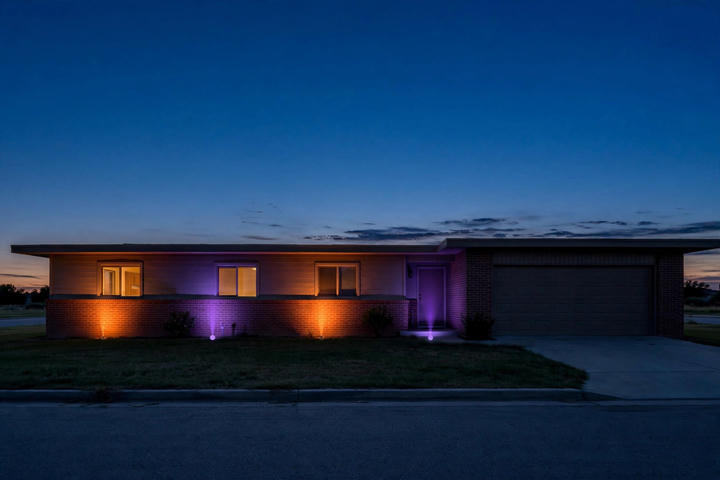
That last sentence is the number nobody prints. A run of eave lights carries a colour across several consecutive lights, because one light per colour reads as a bulb string. A box of fixtures cannot do that — blocking four fixtures would put one colour on the whole set — so fixtures alternate one at a time. A two-pack of wall lights is one orange and one purple. A four-pack of spots is two of each. If you want three colours you need six fixtures, and nothing in this catalogue ships six.
The wall lights are the ones that read from the street
A solar spot is 120 lm. The Govee wall light is 1500 lm a fixture and the UpDown is about 600 lm a fixture across two cones. That is more than a tenfold difference, and it is the difference between accenting a tree and colouring the front of the house.
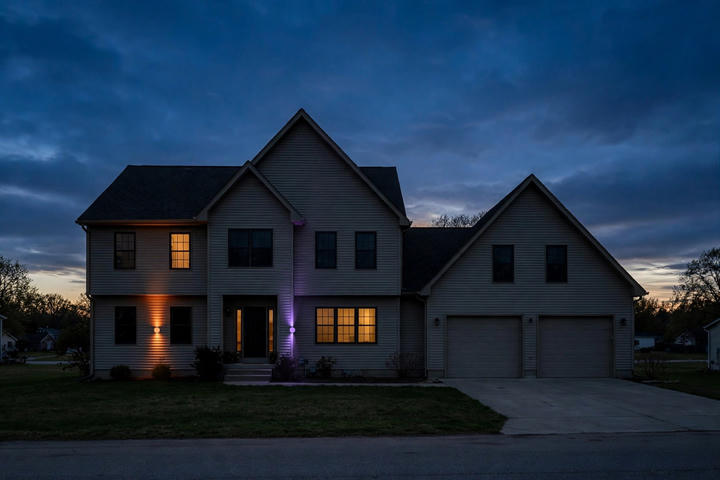
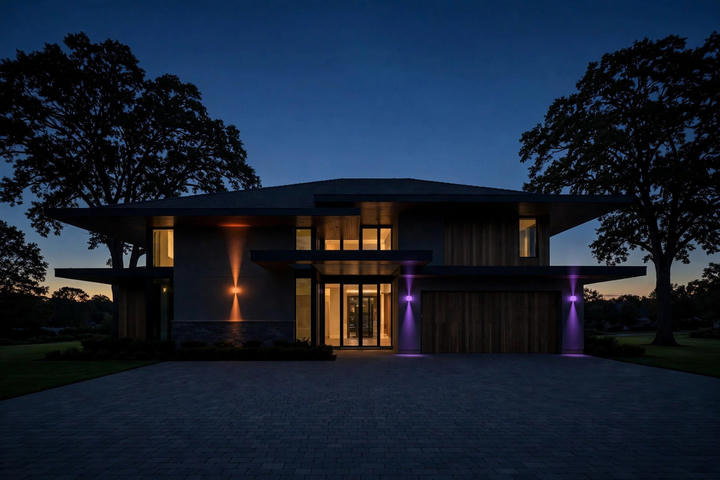
The cost of that brightness is that both are hardwired. This is a fixture replacing a fixture at an existing box, which is an electrician or a confident afternoon with the breaker off — not a thing to start on 30 October. If the wall light is the answer, it is the answer for next year, and it is a far better one than a seasonal purchase because it is still there in February.
Rope and strip want a straight edge under cover
The rope and the strip are the two products here that draw a line at ground level: along a porch ceiling, under a handrail, along the front of a step. Both are 32.8 ft, which is plenty for a porch and not enough for a roof edge.
They are also the two with the tightest colour resolution in the catalogue — 4 in and 9 in — which matters more on a short run than on a long one. Over twenty feet of porch the rope gives you five bands of colour and the strip gives two.
Two cautions, both from the listings rather than from us. The strip is IP65, which is splash and rain and not standing water, so it wants an overhang rather than an exposed step. And the rope’s control box is the part to keep dry on both of them; the run is rated, the box and the adapter are the failure point people report.
The string goes over the space, not on the house
A string light is the one shape here that does not light the building at all. It lights the patio, the pergola or the path under it, which in October is the place people actually stand.
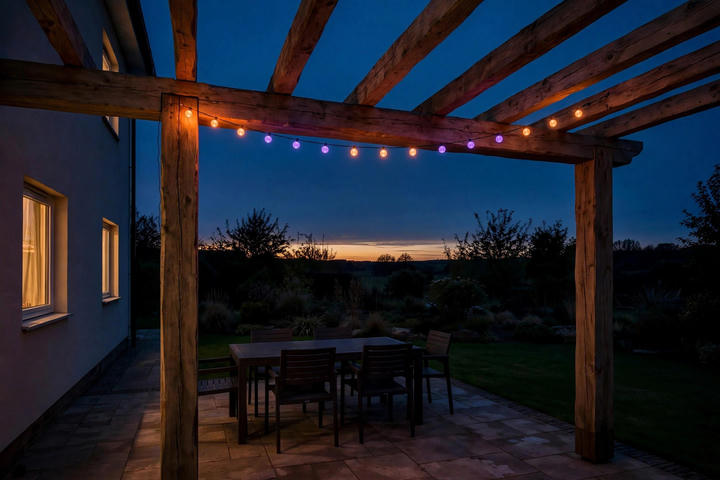
Fifteen bulbs over 48 ft is about three feet between bulbs, so the colour blocks are long and the effect is closer to two lit zones than to a stripe. The 96 ft version doubles it — but it arrives as two 48 ft strands you join, not one reel, which catches people out when they have measured a single continuous run.
On every one of these strings the adapter is the thing that has to stay dry. The cable is rated; the controller is not, and most of the failures on the listings are that step skipped.
What we could not check
We have not installed any of these. Lumen figures, IP ratings and pack sizes are from the listings on the dates printed on each product page.
- No beam angle is published for any spotlight in this catalogue, and none is published for the wall lights either, so “a cone up the wall” is a description of the fixture type rather than a measured spread. How much wall 600 lm actually covers depends on how far off it you mount it.
- Solar runtime is the open question on the spot. Owners in full sun report a full evening; owners in shade report a few hours, and that is the complaint that recurs. In late October the days are short at both ends of that.
- Two zone counts are inferred — the rope’s and the strip’s — so the band arithmetic above is built on the shakiest numbers in the catalogue.
- The pictures are renders. Lights are placed by each product’s own count and pitch by a deterministic renderer. They are not photographs of an installed kit and they are not proof of brightness.
- There is no render of a net over a bush, because the renderer places lights on eaves, walls, walks and spans and has no bush. That gap is why a net does not appear in this article at all.
Then put two of them together
One shape rarely does it. A spot on the tree and a string over the patio, or a wall light by the door and a rope along the porch ceiling, is what the good versions of this look like — and both of those are an evening, not a project.
Every product above is rendered in this scheme on the same sample houses, so you can put two shapes side by side before buying either: the orange-and-purple set is here, and the Halloween hub has the rest of the shelf. If the roof is on the table after all, can permanent lights do orange and purple is the other half of this decision.
Price tiers are our own rough budget bands, not live prices. Check the listing for today’s price.
Frequently asked questions
How do I light my house for Halloween without a ladder?
Use ground-level shapes: wall lights, solar spots, rope or strip lights, and string lights over a patio or pergola. Each lights a different part of the front, and a house that looks properly done usually has two of them.
How many orange and how many purple lights are in a 4-pack?
A four-pack of spots is two orange and two purple. Fixtures alternate one colour at a time, so a two-pack of wall lights is one orange and one purple. For three colours you would need six fixtures, and nothing in this catalogue ships six.
Are solar spotlights bright enough to light a house?
They suit accents rather than the whole front. A solar spot is 120 lm, against 1500 lm per fixture for the Govee wall light and about 600 lm per fixture for the UpDown. That is the difference between accenting a tree and colouring the house.
How long do solar Halloween spotlights stay on?
It depends on sun. Owners in full sun report a full evening, while owners in shade report a few hours. That shade complaint is the one that recurs, and late October days are short at both ends.
Can I install the wall lights just before Halloween?
Probably not. Both wall lights are hardwired, replacing a fixture at an existing box, which is a job for an electrician or a confident afternoon with the breaker off. The guide says not to start it on 30 October, and calls it an answer for next year.