
What the numbers mean
Five to seven feet. The maker’s own recommended distance from the fixture to the thing it lights, and far more useful than any lumen figure. It tells you what this is: a light pushed into the bed at the base of a shrub, a small tree, a stone. Stand it fifteen feet back to catch a gable and you will light nothing. Every disappointed owner we read had the fixture too far from its subject.
Around 120 to 150 lm a fixture, and the sources do not agree. Beside the wired spotlights here the gap is not close: the SUNVIE is 900 lm a head, the DEWENWILS 540. All four of these together are worth less than one SUNVIE. Not a criticism — a specification. No solar spotlight at any price washes a two-storey wall.
Solar, self-contained, no trench. The entire argument. Every other spotlight here needs a transformer at the house and a cable buried out to it. If the thing you want lit is at the back of the garden, this is the only fixture on the page that reaches it.
The panel is on the head, and that is the real compromise. One pivot at the neck carries both. Tilt the light to aim it and the panel tilts with it; lay the panel flat to the sky for the best charge and you have lost the aim. Two things you would rather set independently, on one joint. Work out which matters more before you stake it.
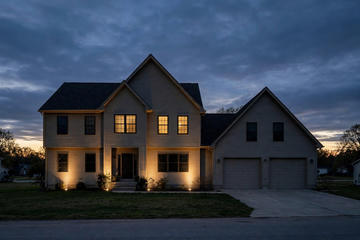
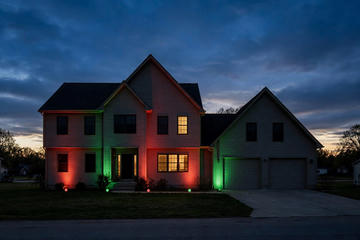
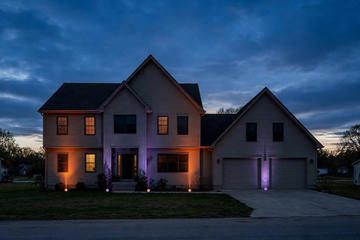
Bluetooth mesh, and the app needs no hub. Worth saying because listings imply otherwise. A hub is needed only for voice assistants, and it is a separate purchase.
Who it is for
- One shrub, one small tree, one piece of stonework, lit from five feet away.
- Anywhere a cable cannot go: a far bed, a rental, an island in the lawn.
- A site with genuinely unobstructed sun for most of the day.
Who should buy something else
- You are lighting a facade or a mature tree: the SUNVIE, wired, at 900 lm and a 90-degree spread. Side by side.
- You want a narrow beam on a trunk: the LEONLITE at 45 degrees. Side by side.
- The bed is shaded by the house, a tree or an eave: buy nothing solar. Wire it.
- You want a fixture to hand on with the house: the VOLT brass kit.
What we could not check
We have not staked these, and this page carries more open questions than most.
The output figure. The maker’s own site says one number, the listing’s spec box says double it, an owner who measured says less than either. We kept the low end; anyone quoting the high figure is quoting marketing.
The beam angle, which we deliberately have not printed because nobody publishes it credibly. The five-to-seven-foot throw is the honest substitute.
The weather rating, where the listing and one independent review say IP67 and another says IP65. On a fixture standing in a lawn those are not the same when the sprinkler runs.
The battery. The maker says it swaps out in a minute with no tools, which if true is the most valuable thing about the product — a replaceable cell is what separates a solar light you keep from one you throw away, and it is why the Beau Jardin path lights lead their category. We found no owner who has actually done it. Do not buy on that promise until someone has.
And the runtime, where the complaints concentrate and the record is genuinely mixed. In full unobstructed sun, owners report a whole night and more than a year of service. In partial shade or under cloud they report a few hours, dimming over about three months, and — the detail that worries us — noticeable variation between fixtures from the same pack staked in the same row. That is not siting, it is cell quality, and it means a bad unit is possible even when you do everything right.
One thing to disregard when reading around: complaints about a motion sensor belong to a different fixture in this range. This one has none.
The rest of spotlights and floods
| Product | Cost tier | Size | Per light | Weather |
|---|---|---|---|---|
| SL5C 4 | Budget | 4-pack | 120 lm | IP67 |
| LEONLITE 6 | Budget | 6-pack | 5 W | IP65 |
| SUNVIE 8 | Budget | 8-pack | 900 lm | IP65 |
| DEWENWILS 4 | Budget | 4-pack | 540 lm | IP65 |
| VOLT brass kit | High-end | 8-pack | 5 W | UL, direct-burial cable |
Price tiers are our own rough budget bands, not live prices. Check the listing for today’s price. The price itself stays on the listing, where it is current, rather than here, where it would go stale. The same catalogue drives the calculator, so a number here and a number there are the same number.