The seasonal lighting aisle is arranged by holiday, and the arrangement costs people money. Orange strands in one bay, red and green in the next, and a household that does both ends up with two sets of hardware, two afternoons on the ladder, and two boxes in the loft.
There is a version of this that is one purchase. It has a real limit on it, and the limit is not the one you would guess.
The split is colour, and it does not follow the shape
Three seasonal strands sit on this site, and only one of them can change colour at all:
| Strand | Shape | Colour |
|---|---|---|
| Brightown smart C9 | C9, 150 bulbs at 8 in over 99 ft | RGB in every bulb — any scheme |
| JMEXSUSS icicle | 80 drops over 39 ft | Warm white only |
| Sylampow net | 6 ft by 5 ft mesh | Warm white only |
The icicle and the net have eight modes on a button at the plug and no app at all. If you want the icicle shape in orange and purple, nothing on this site does it — that is a gap in the catalogue rather than a fact about icicles, and it is worth knowing before you go looking for one here.
Which leaves the smart C9 as the strand that answers the question in the title.
The same strand, two months apart
The C9 is the big-bulb look — opaque retro bulbs about the size of a thumb, clipped along the roof edge — with an RGB chip inside each one. 150 bulbs at eight inches over 99 ft, plus a 16 ft lead, and it links to 300 bulbs.
Eight inches is the classic C9 pitch, so it is the shape rather than one manufacturer’s choice. It is also the second tightest pitch in this whole catalogue, which is why the C9 draws a harder, more legible two-colour alternation than any permanent eave kit here can.
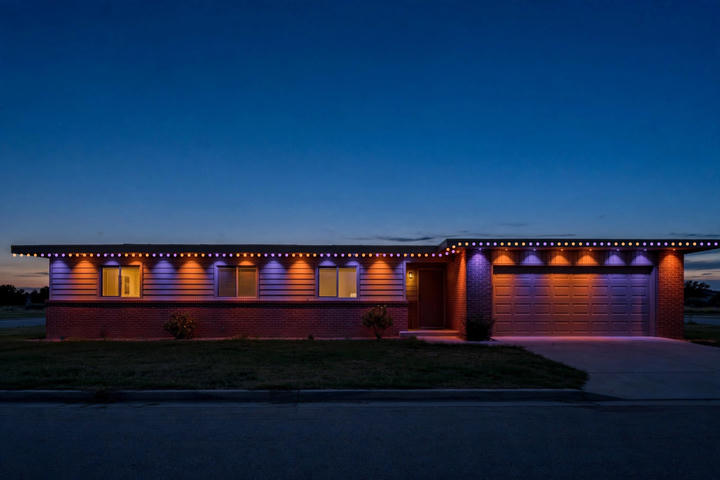
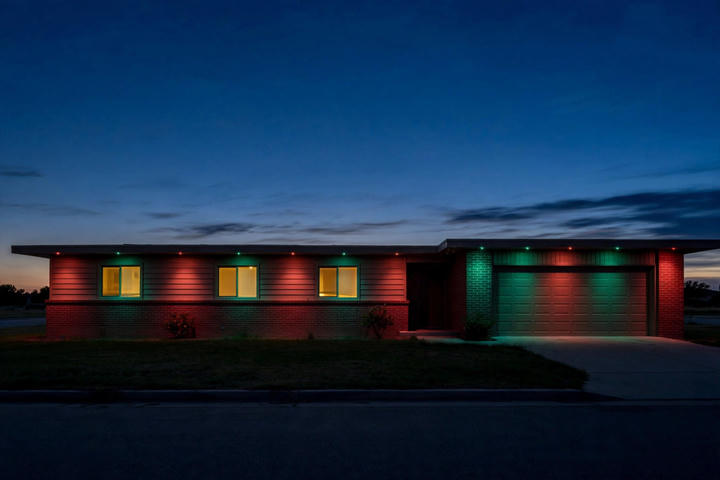
That is the whole argument for the strand, and it is worth being precise about what it saves: one purchase, one measurement, one afternoon on the ladder, one box in the loft. It does not save you taking it down, and a strand on the fascia is not a permanent kit.
What it gives up
Three things, and the first one is the one people find out in November.
Bluetooth only. No wifi, no schedule, no voice. You stand within range of the strand with your phone to change it. That is fine for a two-scheme year and it is genuinely annoying if you wanted the lights to come on at dusk while you are out. Every permanent kit on this site has a schedule; this does not, and it is the clearest single line between the seasonal shelf and the permanent one.
The warm white is a mix. There is no dedicated white die in a C9 bulb, so 2700K is made from red, green and blue and reads a little pinker than a true warm white. For October and December that costs you nothing — neither scheme contains any white. For a January roofline it is the reason the permanent kits exist.
No IP rating is published. The listing says waterproof and prints no number, so we print none. Every other seasonal strand here that publishes a rating publishes IP44, which is rain from any direction and is not a gutter, not standing water and not snowmelt running off a roof. Treat the C9 as rain-only like the rest, hang it on the fascia, and keep it out of the gutter.
How much strand a front takes
The same measurement as a permanent run: the front eave plus both rakes of every gable you mean to light. The measuring guide explains why the rakes are the part everyone forgets, and the calculator turns it into feet.
At 99 ft a strand, one strand covers a front eave and both rakes of a single gable on most houses. It links to 300 bulbs — two strands — with the controller at the plug end of the first. Then buy one more than the arithmetic says, because strands join end to end and the spare is the one you do not reorder in the third week of October.
Or do not take it down at all
The honest competitor to a two-season strand is a kit that never comes down. A permanent eave line does orange and purple in October, red and green in December and a warm white for the rest of the year, on a schedule, without a ladder after the first afternoon.
It costs a great deal more up front and it is a different kind of decision — permanent versus seasonal is the comparison, worked against your own numbers rather than a payback date we invented. The thing the C9 has over all of them is the pitch: at eight inches it draws a tighter alternation than any permanent kit here, the closest of which is 17 in. What it does not have is the schedule, the white, or a tenth winter.
What we could not check
We have not hung any of these. Counts, pitches and ratings are from the listings on the dates printed on each product page, and no app was run.
- The C9’s record. The complaints on strands of this type are specific rather than vague: a strand arriving with a dead section, an individual bulb going dark while the rest run, the app losing the strand and needing a re-pair. None of that is a whole-strand failure pattern, and there are enough owners that one would have surfaced.
- The icicle render draws the top of each drop and not the drop itself. A line along the eave is the best a renderer built for eave lines can do for a fringe, which is why no icicle picture appears in this article.
- The pictures are renders, not photographs of an installed strand, and not proof that either app ships the preset in them.
Then look at both months on one house
Two schemes on one strand is an easy thing to argue about and an easy thing to settle: put them on the same house at the same dusk and the argument ends.
That is what the examples gallery is for. The seasonal strands are rendered on the same sample houses as the permanent kits, so what you are comparing is the hardware — the orange-and-purple set for October and the Christmas hub for December. If the answer turns out to be a kit that stays up, can permanent lights do orange and purple covers which of them draw the tightest band.
Price tiers are our own rough budget bands, not live prices. Check the listing for today’s price.
Frequently asked questions
Can one strand of Christmas lights do both orange and purple and red and green?
Yes, but only the Brightown smart C9 on this site can. It has an RGB chip in every bulb, so it can show any scheme. The icicle and net strands are warm white only.
What do you give up with a colour-changing C9 strand?
Three things. It is Bluetooth only, so there is no wifi, schedule or voice control and you must be within range with your phone. Its warm white is mixed from red, green and blue, so it reads a little pinker. No IP rating is published.
Can I leave a C9 strand up all year like a permanent kit?
It is not a permanent kit. You still take it down, and a strand on the fascia is different from a permanent eave line. The permanent kits on this site have a schedule and a true white, which the C9 does not.
How many C9 strands do I need for the front of my house?
One 99 ft strand covers a front eave and both rakes of a single gable on most houses. It links to 300 bulbs, which is two strands, with the controller at the plug end of the first. Buy one more than the arithmetic says.