Every listing in this category says sixteen million colours, and every one of them is telling the truth. It is also not the question. Orange and purple is an alternating scheme — two colours taking turns along a line — and what decides whether it reads as two colours from the kerb is not the palette.
It is the pitch: how far apart the individually addressable points sit. A kit cannot draw a band of colour narrower than one of its own zones, and the zone is a number on the spec sheet that almost nobody reads before October.
Nineteen kits list the scheme
Of the thirty-four products in this catalogue, nineteen list orange and purple among their schemes: every permanent eave kit, both rope and strip products, all four smart string lights, both smart wall lights, the smart solar spot, and one seasonal strand. Two of the nineteen carry no confirmed listing, so there are seventeen this article can actually point you at.
That is more choice than the category usually gets, and it is why the Halloween hub is a cross-cut of the other shelves rather than a shelf of its own. Nothing here is a Halloween product. Everything here is a product that happens to do October and is still on the house in February.
Pitch is the resolution
Take the front eave of a house and ask how many separate colours can sit along it. The answer is the run divided by the pitch, and the pitch is fixed in the hardware — an app can change the pattern, it cannot move the lights.
| Kit | Run | Zones | Pitch | Bands across a 40 ft front |
|---|---|---|---|---|
| Govee Neon Rope | 32 ft | 96 | 4 in | 10 |
| Brightown smart C9 | 99 ft | 150 | 8 in | 15 |
| Govee Outdoor Strip | 32 ft | 42 | 9 in | 4 |
| Govee Lights 2 | 100 ft | 72 | 17 in | 7 |
| Enbrighten Vibe Eternity | 100 ft | 72 | 17 in | 7 |
| Govee Lights 2, 150 ft | 150 ft | 108 | 17 in | 7 |
| Govee Pro | 100 ft | 60 | 20 in | 6 |
| Linkind HP5 | 100 ft | 60 | 20 in | 6 |
| Govee Pro, 200 ft | 200 ft | 120 | 20 in | 6 |
| Govee Prism | 200 ft | 72 | 33 in | 4 |
The band column needs one thing said about it. A two-colour scheme run one light at a time reads as a bulb string rather than as two colours, so the renders on this site — and the manufacturers’ own presets, and more or less everyone who owns one of these — carry a colour across several consecutive lights. This site’s renderer uses four lights to a band on an eave kit, twelve on a rope or strip, three on a string. That is a modelled choice, and your app may let you set it differently.
What your app cannot change is the pitch. So read the band column as what you get from a sensible preset, and read the pitch column as the floor: the narrowest stripe of orange the hardware is physically able to draw.
The flagship is the worst at this
The Govee Prism is the top of the line — three colours inside each head, a bigger point of light, IP68 rather than IP67, the only kit here rated for immersion. It is also 72 heads over 200 ft, which is a 33 in pitch, the widest in the catalogue.
That pitch is a feature for what the Prism was built to do. Three colours inside one head means it draws gradients, and a gradient wants space to run in. Put the same hardware on a hard two-colour alternation and the space is the problem: each band is nearly eleven feet long, and a 40 ft front holds about four of them.
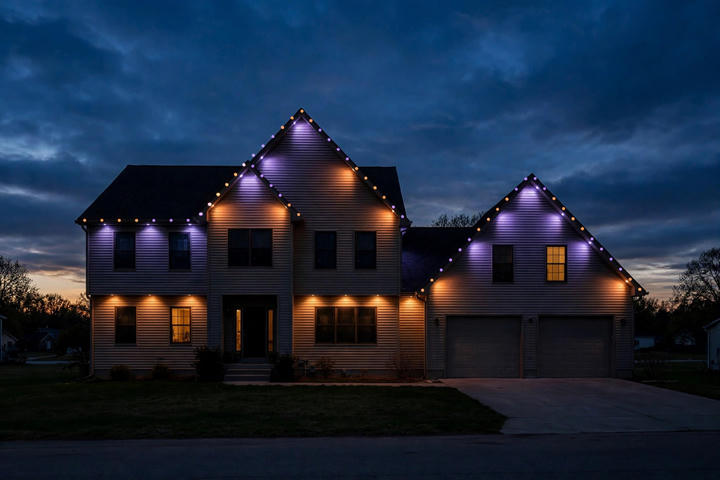
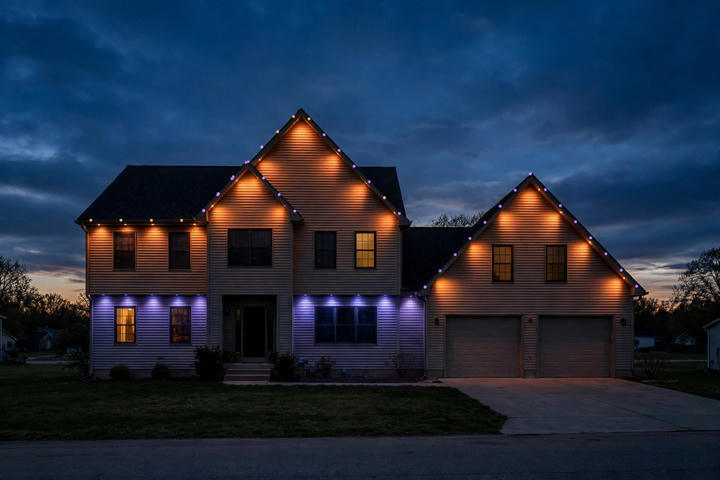
None of that makes the Prism a bad kit. It makes it a kit bought for a different job, and October is the month the difference shows. If the scheme you actually run eleven months of the year is a single warm white or a slow gradient, the pitch never comes up.
The rope is the other end of the scale
At the far end sits the Govee Neon Rope: a continuous flexible tube at a 4 in pitch, which is a colour change eight times more often than the Prism can manage. Blocked at twelve lights to a band it draws bands about four feet long, and the edges between them are soft rather than stepped, because the rope is a lit line and not a row of points.
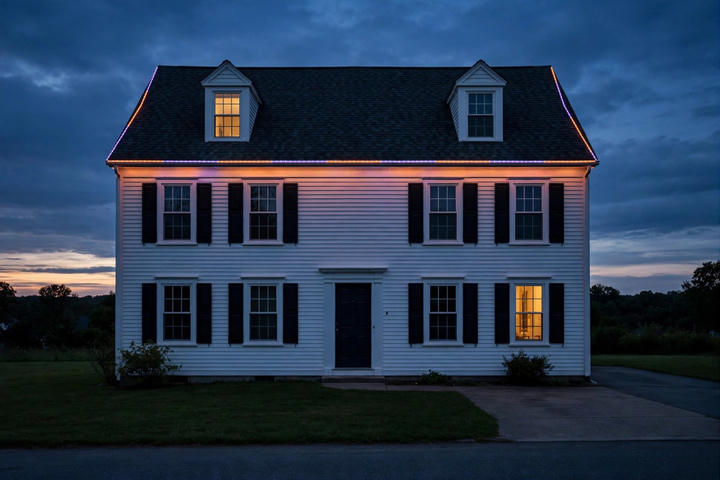
The catch is length. The rope and the strip are both 32.8 ft products, and a front eave plus both rakes of one gable is usually more than that — so the tight pitch costs you either a join or a shorter run than you wanted. The measuring guide is the way to find out which before you order, and the calculator does the arithmetic.
October is the month the cheap string is not compromised
There is a split running through this whole catalogue between kits whose white comes from a dedicated warm-white die and kits that mix white out of red, green and blue. It is the main argument in warm white or cool white, and it is the reason the Govee S14 costs what it does next to the H7015: same length, same fifteen bulbs, and one of them fakes 2700K.
For orange and purple, that entire argument is irrelevant. Neither colour is white, neither is mixed with a white channel, and an RGB chip renders both of them exactly as well as an RGBWW one does. If the string is going up for October on a pergola and coming down in November, the cheaper of the two is not a compromise in any way you will see.
It is a compromise for the other eleven months, which is the whole point of buying a kit that stays up. Decide which of those you are doing before you decide which string to buy.
Two we cannot point you at
Two of the nineteen have no page on this site and no link anywhere on it: a Govee solar string at 32.8 ft, and a Govee path light 4-pack. Both list the scheme. Neither has a confirmed listing behind it, so neither gets a product page at all rather than one with a dead button on it — a link built from a guessed ASIN is a broken promise, not a placeholder.
They are held back for opposite reasons. The path light has an exact US listing and is waiting on two figures. The solar string is waiting on a better product: every candidate at that length fails on its record, on a second-season battery cluster, or both, which is a fact about solar-plus-colour as a category rather than about one bad unit. If a solar string is what you were hoping for, that is the honest answer this site has — not yet.
What we could not check
We have not hung any of these, and no app was run on any of them. Every zone count, pitch and run length above is from the listing or the manufacturer’s page on the date printed on that product’s page.
Three specific limits, because they are where this article is thinnest:
- Two zone figures are inferred. The rope’s 96 segments and the strip’s 42 are read off a per-unit figure rather than a spec sheet — both listings print an LED count and no addressable-segment count. They are marked as guesses in the catalogue and they should be treated as the shakiest rows in the table above.
- The four-light band is ours. It is this site’s renderer’s rule, applied consistently so every picture on the site is comparable with every other. It is not a manufacturer’s preset and nobody measured one to arrive at it. The pitch column is the hardware; the band column is a modelled look.
- The pictures are renders. They are drawn by a deterministic renderer that places lights by each product’s own count and spacing. They are not photographs of an installed kit, they are not proof of brightness, and a simulated orange-and-purple scene is not proof that a kit’s app ships the preset you want.
Then look at it on your own front
The table settles which kits can draw a tight band and which cannot. It does not settle whether your house wants six bands or fifteen, because that is a question about a 40 ft front against a 110 ft one, and about how far back the street is.
Every kit above is rendered in this scheme on the same sample houses, so the only thing changing between two pictures is the hardware — the whole orange-and-purple set is here. When you have picked a shape, the Halloween hub has the rest of the shelf, and one strand for October and December is the question most people ask next.
Price tiers are our own rough budget bands, not live prices. Check the listing for today’s price.
Frequently asked questions
Which permanent lights can do orange and purple?
Nineteen of the thirty-four products in this catalogue list orange and purple, including every permanent eave kit, both rope and strip products, all four smart string lights and both smart wall lights. Two of the nineteen have no confirmed listing, so seventeen can be linked.
Why does orange and purple look blurry or blocky on some kits?
It comes down to pitch, the distance between individually addressable points. A kit cannot draw a band narrower than one zone. The Govee Prism has a 33 in pitch, the widest here, so a 40 ft front holds only about four bands.
Which product draws the tightest orange and purple bands?
The Govee Neon Rope has the tightest pitch at 4 in, and it draws soft-edged bands about four feet long. The catch is length: it is a 32.8 ft product, so a longer front means a join or a shorter run than you wanted.
Does a cheaper RGB string look worse for orange and purple?
No. Neither colour is white, so an RGB chip renders both exactly as well as an RGBWW one. The cheaper string is only a compromise for the rest of the year, when you want a true warm white.