
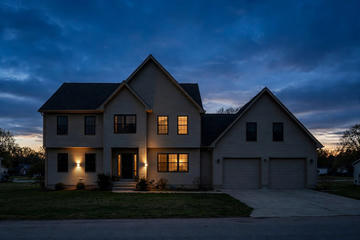
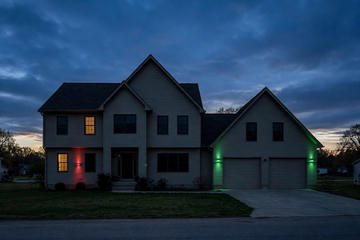
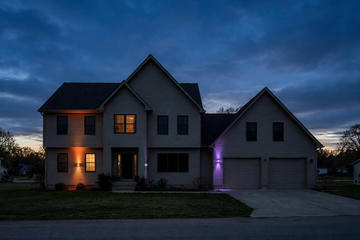
What the numbers mean
1500 lm a fixture, and it is a glowing panel rather than a beam. No reflector, nothing to aim: a frosted block on a black backplate that lights up, throwing forward with a modest halo around it. So the hub’s rule about 1500 lm washing a two-storey wall needs qualifying. The output is real, but spread across a diffuser it reads as a bright fixture, not a bright wall and certainly not a lit doorstep. Buy it for a luminous object beside the door, not to see the keyhole.
Still the most light per fixture in this hub. The UpDown quotes 1200 lm across a pack of two split between an up cone and a down cone — call it 600 lm a fixture over two directions. This puts 1500 out of one face. People assume the up-down box is the upgrade; on output it is not close.
Aluminium, not plastic, and a longer warranty. The UpDown is a plastic housing on twelve months; this is aluminium on two years. On a fixture bolted to a wall for a decade that is worth more than a scene count.
IP65, and no gasket in the box. One step below the UpDown’s IP66, and the maker’s own instructions tell you to run a bead of weatherproof caulk where the fixture meets the wall, with no sealing ring supplied to do that job instead. The caulk is part of the install, not optional tidying.
Hardwired at 120 V, with no photocell. A junction box on a switched circuit — not a plug, not a battery. And it has no idea whether the sun is up: “on at dusk” is a clock schedule in an app, not a sensor.
Who it is for
- A modern facade wanting a clean, low-profile lit object either side of the door or on the garage piers.
- Anyone already running this app who wants the walls on the same schedule and seasonal scheme as the eaves.
- People who want maximum output per fixture from a smart wall light and are not buying it for the up-cone.
Who should buy something else
- You want the two-cone architectural look: the UpDown, accepting plastic, less light, and a shorter warranty for it. Side by side.
- You want a traditional lantern and your own choice of bulb: the Emliviar, with no app at all. Side by side.
- You want it to switch itself with nothing to configure: the hykolity has a photocell and no radio, and this page is the reason we keep saying that is the more robust design.
- You want a designer fixture: the Kichler.
What we could not check
We have not mounted these. The specs came off a European listing and were confirmed against a US one on the date at the top — pack size, output per fixture and weather rating all held.
The complaint that repeats is the app rather than the hardware, and owners divide sharply on it. Scheduling is where it lands: no dusk-to-dawn, timings set by hand, and automations through the smart-home standard reported as unreliable even though the fixture speaks it. If the appeal here is “it turns itself on and I forget about it”, that is the part to be sceptical of.
We found no pattern of water getting in, including from owners through a wet coastal winter and near 0°F. Read that as a good sign rather than a verdict — the sample is not large and there is no multi-winter record yet.
The bracket is a hook-first design that owners rate highly: you hang the fixture before you fasten it, which is a real kindness on a ladder. But the wall has to be flat and level, and on brick the set screws are fiddly to line up.
And one thing no listing photograph tells you. Unlit, in daylight, it is a white plastic-faced block on your wall, and at least one owner disliked exactly that. Stand where your visitors stand and picture it switched off, because that is how you will see it most of the time.
The rest of outdoor wall lights
| Product | Cost tier | Size | Per light | Weather |
|---|---|---|---|---|
| UpDown 2 | Mid-range | 2-pack | 600 lm | IP66 |
| Wall 2 | Budget | 2-pack | 1500 lm | IP65 |
| Emliviar 2 | Budget | 2-pack | — | UL wet location |
| hykolity 18 | Budget | 2-pack | — | ETL wet location |
| Kichler Cylinder | Budget | 1-pack | — | UL wet location |
Price tiers are our own rough budget bands, not live prices. Check the listing for today’s price. The price itself stays on the listing, where it is current, rather than here, where it would go stale. The same catalogue drives the calculator, so a number here and a number there are the same number.